

How AI and Precision Agriculture Technology are Changing Modern Agriculture
How AI and Precision Agriculture Technology Are Changing Modern Agriculture
Agriculture has always been a story of adaptation. Farmers have spent centuries reading soil, sky, and season to coax food from the land. What's different now is the scale and speed of the tools available to them. Across fields on every continent, sensors quietly log soil moisture, satellites track crop health from orbit, and software translates all of it into decisions a farmer can act on before breakfast.
This shift has a name: AI and precision agriculture technology. It's not a single gadget or app — it's a layered system of sensors, algorithms, machinery, and data platforms working together to make farming more precise, less wasteful, and more resilient. By 2026, this approach has moved well past the early-adopter stage and is shaping how mainstream farms of every size operate.
This article walks through what AI in agriculture and precision farming actually mean, the technologies behind them, real companies putting them to work, the benefits and challenges, and where the field is headed through 2035.
What is AI in Agriculture?
Artificial intelligence in agriculture refers to software systems that analyze farm data — images, sensor readings, weather patterns, historical yields — and turn it into predictions or recommendations. Instead of a farmer manually inspecting every acre, an AI model can scan thousands of images from a drone flight and flag the ten spots showing early signs of disease.
At its core, AI in farming relies on machine learning, a branch of AI where algorithms improve by learning from examples rather than being explicitly programmed for every scenario. Feed a model thousands of images of healthy and diseased corn leaves, and it learns to tell the difference on its own, then applies that pattern to new fields it has never seen.
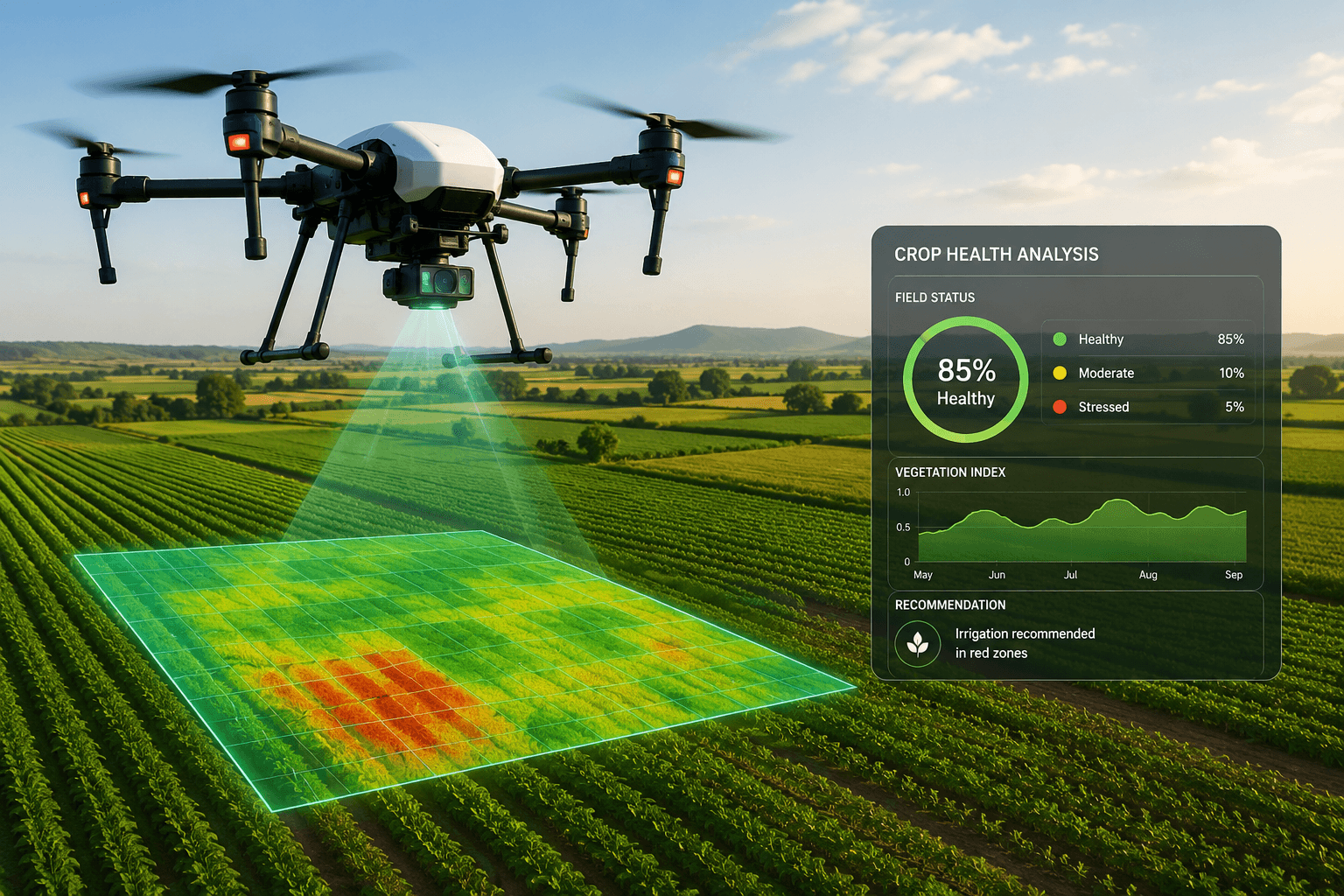
Why does this matter? Because farming decisions are enormously consequential and time-sensitive. A delayed pest response can wipe out a harvest. Over-irrigating wastes a scarce resource and can leach nutrients from soil. AI doesn't replace a farmer's judgment, but it narrows the gap between "something might be wrong" and "here's exactly where, and here's what it likely is."
What is Precision Agriculture?
Precision agriculture is the broader practice of managing crops and livestock at a fine-grained level — sometimes down to individual plants — rather than treating an entire field as a single uniform unit. The core principle is simple: apply the right input (water, fertilizer, pesticide, seed) in the right amount, at the right place, at the right time.
Three ideas anchor precision agriculture:
Site-specific management — recognizing that soil type, moisture, and pest pressure vary across a single field, so treatment should vary too.
Data-driven decisions — using measurements rather than guesswork or blanket schedules.
Continuous feedback — monitoring outcomes and refining the approach season over season.
The objective isn't just higher yield. It's higher yield with less waste, lower cost per acre, and a smaller environmental footprint — a combination that matters as much to a farm's balance sheet as it does to its sustainability credentials.
Traditional Farming vs. Precision Agriculture
The contrast becomes clearest side by side.
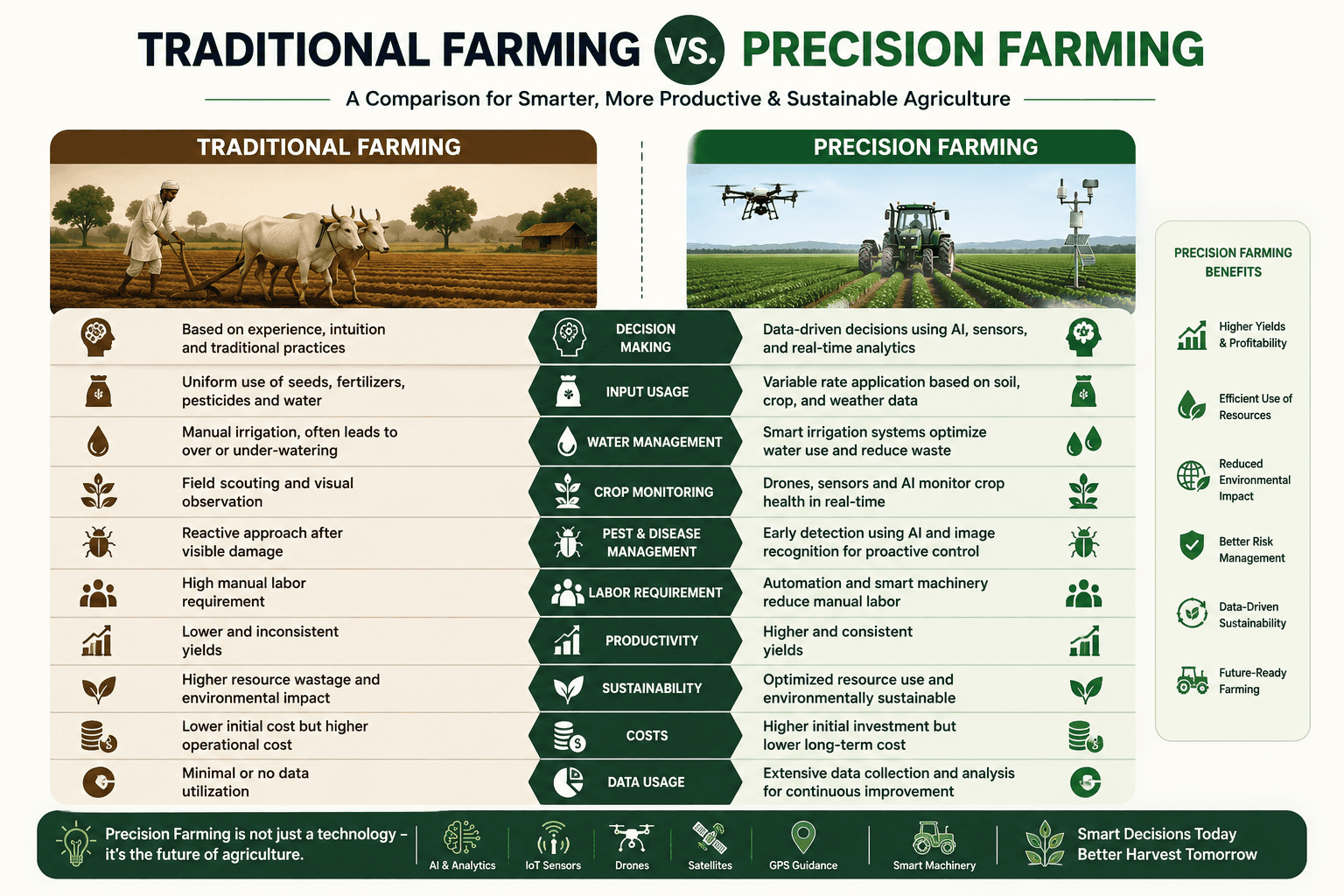
Factor | Traditional Farming | Precision Agriculture |
|---|---|---|
Decision making | Based on experience and uniform field assumptions | Based on real-time data and field-specific analysis |
Fertilizer usage | Applied evenly across the field | Applied at variable rates matched to soil needs |
Water management | Fixed irrigation schedules | Smart irrigation triggered by soil moisture data |
Crop monitoring | Manual, periodic field walks | Continuous monitoring via drones, satellites, sensors |
Pest management | Reactive, often field-wide spraying | Targeted spraying at detected trouble spots |
Labor requirements | Higher, more manual scouting and application | Lower for monitoring; higher skill for tech operation |
Productivity | Variable, dependent on experience | Generally higher and more consistent |
Sustainability | Harder to optimize resource use | Reduced input waste and emissions |
Costs | Lower upfront, higher long-term waste | Higher upfront investment, lower ongoing waste |
Data usage | Minimal or anecdotal | Central to every major decision |
Neither approach is inherently "wrong" — many precision tools are simply an evolution of long-standing agronomic practices, applied with better instruments.
Why AI and Precision Agriculture Matter in 2026
Several pressures are converging on agriculture at once, and they explain why adoption has accelerated rather than stayed a niche interest.
Global food demand continues to climb as the world population grows, while the amount of arable land per person shrinks. Producing more food from the same or less land is no longer optional.
Labor shortages are affecting farms in nearly every major agricultural region. Skilled farm labor is harder to find and retain, pushing farms toward automation for tasks like weeding, monitoring, and even harvesting.
Climate change has made weather less predictable. Droughts, floods, and shifting growing seasons mean farmers need tools that adapt in near real time rather than relying on historical averages alone.
Water scarcity is a growing constraint in many farming regions, making smart irrigation less of a convenience and more of a necessity.
Rising input costs — fertilizer, fuel, seed — mean that waste is expensive in a way it wasn't a generation ago. Precision application directly protects margins.
Sustainability goals and carbon footprint reduction are increasingly tied to market access, subsidies, and consumer expectations, giving farms additional incentive to document and reduce their environmental impact.
Together, these forces mean precision agriculture isn't just a productivity upgrade — it's becoming a resilience strategy.
Core Technologies Behind Precision Agriculture
Precision agriculture is built from several interlocking technology layers.
Artificial Intelligence and Machine Learning form the analytical core, spotting patterns in crop images, weather data, and historical yields that would take a human far longer to detect.
Computer Vision allows cameras on drones, tractors, or fixed poles to "see" crop health, count plants, or identify weeds by visually distinguishing them from crop rows.
IoT Sensors placed in soil or on equipment continuously report moisture, temperature, and nutrient levels back to a central platform.
Smart Irrigation systems use that sensor data to water only where and when it's needed, often controlled remotely from a phone.
GPS Technology and GIS Mapping let equipment navigate fields with centimeter-level accuracy and let farmers layer data — soil type, yield history, elevation — onto digital maps of their land.
Satellite Imaging and Remote Sensing provide a bird's-eye view of crop health across entire farms or regions, useful for spotting stress before it's visible on the ground.
Drone Technology offers a closer, more frequent look than satellites can, useful for targeted scouting and spraying.
Agricultural Robotics and Autonomous Tractors handle repetitive or labor-intensive tasks — planting, weeding, harvesting — with minimal human oversight.
Precision Sprayers use sensors to detect individual weeds or pests and apply chemicals only where needed, rather than blanketing a field.
Big Data Analytics, Cloud Computing, and Edge Computing store and process the enormous volume of data these tools generate, with edge computing handling time-sensitive analysis directly on equipment when a live internet connection isn't reliable.
5G Connectivity is beginning to make real-time data transfer from remote fields far more practical than older rural connectivity allowed.
Blockchain in Agriculture is emerging mainly around supply chain traceability — verifying where food came from and how it was grown, which matters for premium markets and food safety compliance.
Top AI Applications in Agriculture
AI shows up across nearly every stage of the farming cycle:
Crop monitoring — continuous tracking of plant health using image analysis
Disease detection — identifying fungal, bacterial, or viral symptoms often before visible to the naked eye
Weed identification — distinguishing weeds from crops for targeted removal
Yield prediction — forecasting harvest volume based on current crop conditions and historical data
Weather forecasting — hyperlocal forecasts tailored to a specific field rather than a broad region
Livestock monitoring — tracking animal health, movement, and feeding patterns via wearables
Soil analysis — assessing nutrient composition and recommending amendments
Precision spraying — applying pesticides or herbicides only where sensors detect a need
Harvest prediction — timing harvest for optimal ripeness and quality
Autonomous farming equipment — machinery that plants, weeds, or harvests with limited supervision
Farm management systems — centralized software that ties together every data stream into one dashboard
Supply chain optimization — matching harvest timing and volume with logistics and demand
Market forecasting — predicting price trends to inform planting and selling decisions
Precision Agriculture Technologies Used Today
On a working farm in 2026, this typically looks like:
Soil sensors buried at multiple depths, reporting moisture and temperature continuously
Weather stations positioned directly in fields rather than relying on the nearest airport reading
Drone mapping flights conducted weekly or after major weather events
Satellite imagery subscriptions providing regular vegetation-health snapshots
Variable Rate Technology (VRT) equipment that adjusts seed, fertilizer, or chemical application on the fly as it moves across a field
GPS-guided tractors that reduce overlap and skips during planting or spraying
Smart irrigation controllers that respond to live soil-moisture readings
AI cameras mounted on equipment or fixed in barns for continuous monitoring
Livestock wearables tracking activity, temperature, and rumination
Farm management software consolidating all of the above into one interface
Benefits of AI and Precision Agriculture
The appeal of these systems comes down to a fairly consistent set of measurable gains:
Higher crop yields through better-timed and better-targeted interventions
Lower operational costs by cutting waste on fertilizer, water, and chemicals
Water conservation through irrigation matched to actual plant need
Reduced fertilizer use via variable-rate application instead of blanket coverage
Improved pest management through early, localized detection
Better decision-making, informed by data rather than intuition alone
Labor savings, particularly for repetitive monitoring and application tasks
Increased profitability, driven by the combination of higher output and lower input costs
Reduced environmental impact, from less chemical runoff to lower fuel use
More sustainable farming, supporting long-term soil and water health
Real-World Examples
A number of established agricultural and technology companies have built precision agriculture into their core offerings.
John Deere has integrated GPS guidance, autonomous tractor capability, and AI-based "See & Spray" technology that identifies and treats weeds individually rather than spraying entire fields.
Climate FieldView, from Bayer's digital farming division, aggregates field data — planting, soil, weather, yield — into a single platform farmers use to plan and evaluate each season.
Trimble Agriculture is known for GPS guidance and precision application systems used across tractors and implements from multiple manufacturers.
DJI Agriculture produces agricultural drones widely used for crop spraying and field mapping, particularly in Asia's precision farming market.
AGCO builds precision-ready equipment and offers its own digital ag platform for combining machine and field data.
CNH Industrial, parent of brands like Case IH and New Holland, has invested heavily in autonomous and precision equipment across its product lines.
Bayer's Digital Farming initiatives (including Climate FieldView) combine agronomic expertise with data platforms to guide input decisions.
Syngenta's Digital Agriculture programs focus on combining crop science with data tools for disease and pest prediction.
Microsoft FarmBeats is a research-driven initiative applying AI and low-cost sensors to bring precision agriculture tools to farms that might otherwise lack the infrastructure for it.
IBM's agriculture-focused AI work (building on its Watson AI research) has explored weather modeling and decision-support tools for large-scale farm operations.
These companies illustrate a common pattern: equipment manufacturers are increasingly software companies as much as machinery builders, and the value of their products depends heavily on the data platforms behind them.
AI Tools Used in Modern Agriculture
The precision agriculture software market has matured into distinct categories. Below is a representative look at the kinds of tools farms use today, grouped by purpose.
Farm management platforms (e.g., Climate FieldView, Trimble Ag Software, Granular) centralize field records, input tracking, and yield data. Best for farms of any size wanting one dashboard instead of scattered spreadsheets.
Crop imaging and scouting tools (e.g., Taranis, Sentera) use drone or satellite imagery with AI analysis to flag disease, pest, or nutrient issues. Ideal for row-crop operations covering large acreage.
Soil and irrigation platforms (e.g., CropX, Netafim's digital farming tools) combine soil sensors with irrigation scheduling. Best suited to water-constrained regions or high-value irrigated crops.
Livestock monitoring systems (e.g., Allflex, Cowlar) use wearables to track animal health and behavior. A strong fit for dairy and cattle operations focused on herd health and productivity.
Autonomous equipment platforms (e.g., John Deere Operations Center, Monarch Tractor) manage fleets of autonomous or semi-autonomous machinery. Best for large operations facing labor shortages.
Yield and weather prediction tools (e.g., aWhere, Prospera) apply machine learning to weather and crop data for forecasting. Useful for both individual farms and agribusinesses managing supply contracts.
Precision spraying systems (e.g., See & Spray, Bilberry) identify weeds for targeted herbicide application. Best for large-scale row-crop farms looking to cut chemical costs.
Across these categories, the common advantages are reduced input waste, earlier problem detection, and centralized decision-making — while the ideal user varies by farm size, crop type, and existing infrastructure.
Challenges of AI and Precision Agriculture
Despite the clear upside, adoption isn't frictionless.
High implementation costs remain a real barrier, particularly for small and mid-sized farms where sensors, software subscriptions, and compatible equipment represent a significant upfront investment.
Internet connectivity in rural areas is often inconsistent, which limits real-time data transfer and pushes some farms toward edge-computing solutions instead.
Data privacy is a growing concern, since farm data can reveal sensitive information about yields, financial performance, and land use that farmers may not want shared with equipment manufacturers or third parties without clear agreements.
Farmer training is essential but often underestimated — a sensor network is only useful if someone on the farm knows how to interpret and act on its output.
Integration complexity arises when equipment and software from different manufacturers don't communicate well with each other, forcing farms to manage multiple disconnected systems.
Infrastructure limitations, from unreliable power to a lack of local technical support, can slow adoption in certain regions.
Maintenance of sensors, drones, and autonomous equipment adds an ongoing cost and skill requirement that traditional farming didn't require.
ROI considerations matter enormously — not every tool pays for itself on every farm, and matching the right technology to the right operation size and crop type is critical to avoid wasted investment.
Future Trends (2026–2035)
Looking ahead, several developments are likely to shape the next decade of precision agriculture.
AI-powered autonomous farms — operations where planting, monitoring, and harvesting run with minimal direct human operation — are moving from pilot projects toward broader commercial use.
Swarm robotics involves fleets of smaller robots working a field collaboratively, offering more flexibility than a single large autonomous machine.
Digital twins for agriculture create virtual models of a farm that simulate how different decisions — planting dates, irrigation schedules — would play out before they're applied in the real world.
Generative AI farm assistants are beginning to let farmers ask natural-language questions about their fields and receive plain-language recommendations, rather than needing to interpret raw dashboards themselves.
Hyper-precision farming pushes site-specific management down to the individual plant level rather than management zones within a field.
Predictive agriculture aims to anticipate problems — pest outbreaks, disease pressure, market shifts — before they visibly affect a crop.
AI-powered climate adaptation tools help farmers adjust planting decisions in response to shifting rainfall and temperature patterns specific to their region.
Carbon farming technologies are emerging to measure and verify carbon sequestration on farmland, increasingly tied to carbon credit markets.
Smart greenhouses and vertical farming apply many of the same sensor and AI principles in fully controlled environments, often in or near urban areas.
Regenerative agriculture supported by AI combines soil-health-focused farming practices with the monitoring tools needed to measure their long-term impact.
Best Practices for Adopting AI in Agriculture
The right starting point depends heavily on farm size and resources.
Small farms generally benefit most from starting with a single, well-defined problem — such as irrigation scheduling — using affordable sensor kits rather than attempting a full platform overhaul at once.
Medium-sized farms often see the best return by adopting a farm management platform first to consolidate existing data, then layering in imaging or variable-rate tools where the data shows the clearest need.
Large enterprises typically have the scale to justify autonomous equipment and enterprise-grade analytics, but should prioritize integration between systems from different vendors to avoid fragmented data.
Agribusinesses supplying inputs or purchasing crops can add value by helping their farmer customers interpret precision data, turning adoption into a shared investment rather than a cost borne by the farm alone.
Across all farm sizes, the most consistent piece of advice from experienced adopters is to start with a clear problem to solve, rather than acquiring technology for its own sake, and to budget for training alongside equipment.
Frequently Asked Questions
What is AI in agriculture?
AI in agriculture refers to software that analyzes farm data — images, sensor readings, weather, and historical records — to generate predictions or recommendations that support farming decisions.
What is precision agriculture?
Precision agriculture is a farming approach that manages inputs like water, fertilizer, and pesticides at a site-specific level rather than uniformly across an entire field.
How does AI improve farming?
AI improves farming by detecting problems earlier, predicting yields more accurately, and enabling targeted rather than blanket application of resources.
Is precision agriculture expensive?
Costs vary widely. Basic tools like soil sensors are relatively affordable, while autonomous equipment and full-platform integration represent a larger investment.
What technologies are used in smart farming?
Common technologies include IoT sensors, GPS guidance, drones, satellite imagery, AI-based crop imaging, smart irrigation, and farm management software.
Can small farmers use AI?
Yes. Many tools, including low-cost sensor kits and mobile-based farm management apps, are designed to be accessible to small and mid-sized operations.
What is Variable Rate Technology?
Variable Rate Technology (VRT) allows equipment to automatically adjust the rate of seed, fertilizer, or chemical application as it moves across different zones of a field.
What are the benefits of agricultural drones?
Drones allow frequent, detailed crop monitoring and targeted spraying, catching issues earlier than periodic manual field walks would.
What is precision crop management?
Precision crop management is the practice of tailoring planting, irrigation, fertilization, and pest control to the specific needs of different areas within a field.
What is the future of AI in agriculture?
The future points toward greater autonomy, predictive rather than reactive decision-making, and AI assistants that let farmers interact with their data in plain language.
Does precision agriculture require internet access?
Continuous connectivity is helpful but not always required — many systems use edge computing to process data locally and sync when a connection is available.
How is livestock farming affected by AI?
AI-driven wearables and monitoring systems track individual animal health, movement, and feeding patterns, allowing earlier intervention for sick or stressed animals.
What is the role of satellite imagery in agriculture?
Satellite imagery provides broad, regular snapshots of crop health across large areas, useful for identifying stressed zones that need closer inspection.
Can precision agriculture reduce environmental impact?
Yes. By applying inputs only where needed, it typically reduces chemical runoff, water waste, and fuel use compared to uniform field treatment.
What skills do farmers need for precision agriculture?
Basic data literacy, familiarity with farm management software, and the ability to interpret sensor or imaging reports are increasingly important alongside traditional agronomic knowledge.
Are autonomous tractors widely used yet?
Adoption is growing but still concentrated among larger operations that can justify the investment; broader adoption across farm sizes is expected over the coming decade.
What is a digital twin in agriculture?
A digital twin is a virtual model of a farm or field used to simulate the effects of different management decisions before applying them in real life.
Conclusion
AI and precision agriculture technology represent one of the most significant shifts modern farming has seen in decades. The combination of sensors, imaging, machine learning, and automation gives farmers a level of insight into their fields and livestock that simply wasn't possible a generation ago. The result is farming that can be more productive, more cost-effective, and lighter on natural resources at the same time.
Adoption isn't without real challenges — cost, connectivity, training, and integration all require thoughtful planning. But the direction is clear: from smallholder farms experimenting with a single soil sensor to large enterprises running autonomous fleets, precision agriculture is becoming a standard part of how food gets grown.
For farmers, agribusinesses, and investors evaluating where to start, the most practical first step is identifying one concrete problem — water use, pest pressure, yield variability — and choosing a tool built to solve it well. From there, the path toward a fully data-driven farm operation becomes far less daunting, and considerably more rewarding.
[ Blog ]


