
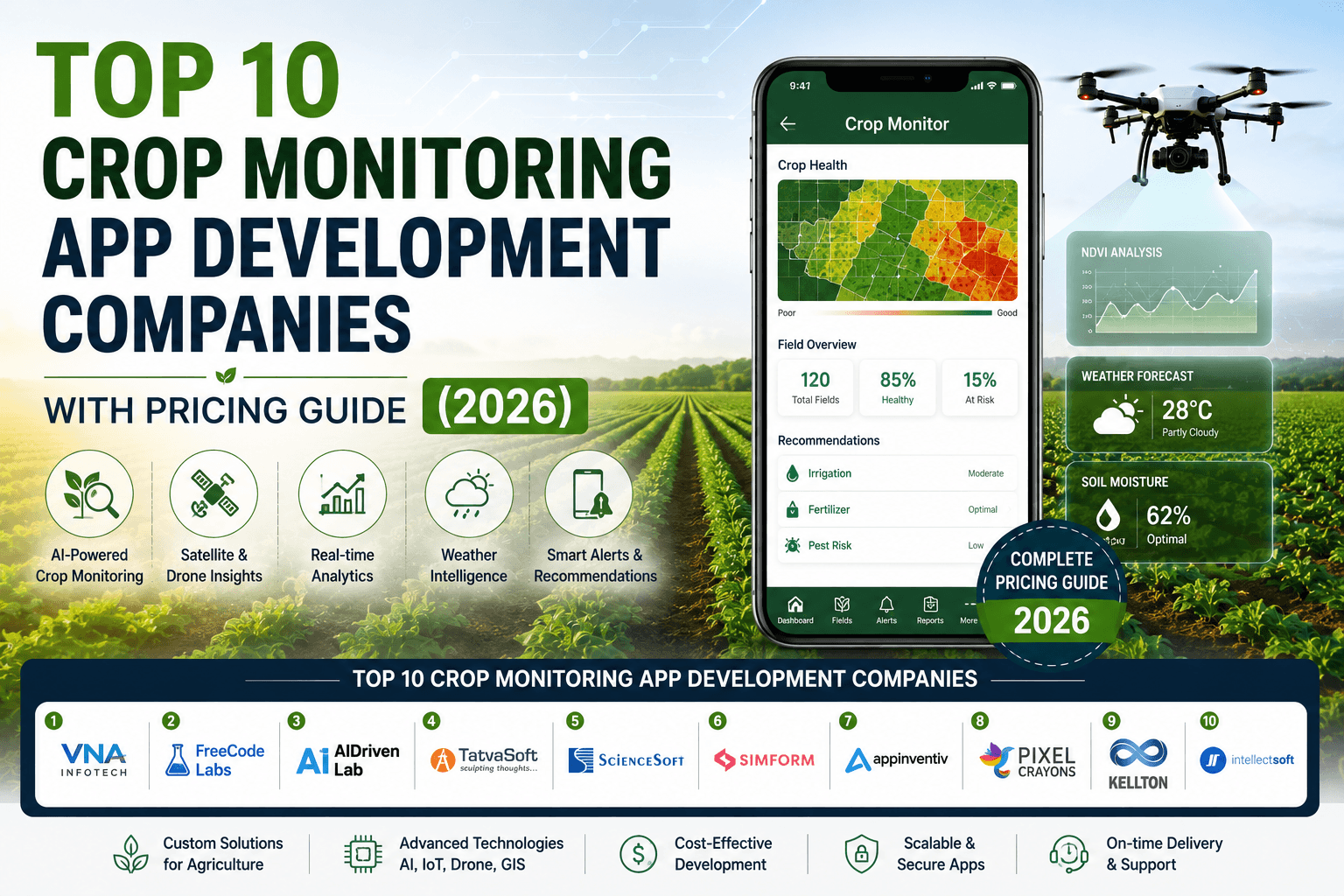
Top Crop Monitoring App Development Companies with Pricing Guide (2026)
Introduction
Farming used to run on instinct, experience, and a farmer's eye for a field. It still does — but increasingly, that instinct is backed by satellite imagery, soil sensors, and AI models that can spot a disease outbreak before it's visible to the naked eye. Digital agriculture has moved from pilot projects to standard operating procedure across large agribusinesses, cooperatives, and even mid-sized family farms.
Crop monitoring apps sit at the center of this shift. They pull together satellite data, drone imagery, IoT sensor readings, and weather intelligence into a single dashboard that tells a farmer — or an agronomist managing thousands of hectares — exactly what's happening in the field right now, and what's likely to happen next.
For agribusinesses, agritech startups, and government agriculture departments evaluating whether to build one, the two questions that matter most are: which development company should build it, and what will it actually cost?
This guide answers both. You'll find a detailed look at ten established software development companies capable of building crop monitoring platforms, a complete pricing breakdown by app complexity and region, the technology stack behind modern AI-powered agriculture apps, realistic timelines, and a practical checklist for choosing the right development partner.
A quick note on how this guide was put together: company profiles below are based on publicly available information — company websites, verified business databases, and press coverage. Where a company doesn't publicly disclose certain details (like a full client roster or a numeric review score), we've said so rather than guessing. You should always confirm current pricing, portfolio, and specific agricultural experience directly with any vendor before signing a contract.
What Is a Crop Monitoring App?
A crop monitoring app is a software platform — typically combining a mobile app, web dashboard, and backend data engine — that tracks the health, growth, and environmental conditions of crops across one or more fields in near real time.
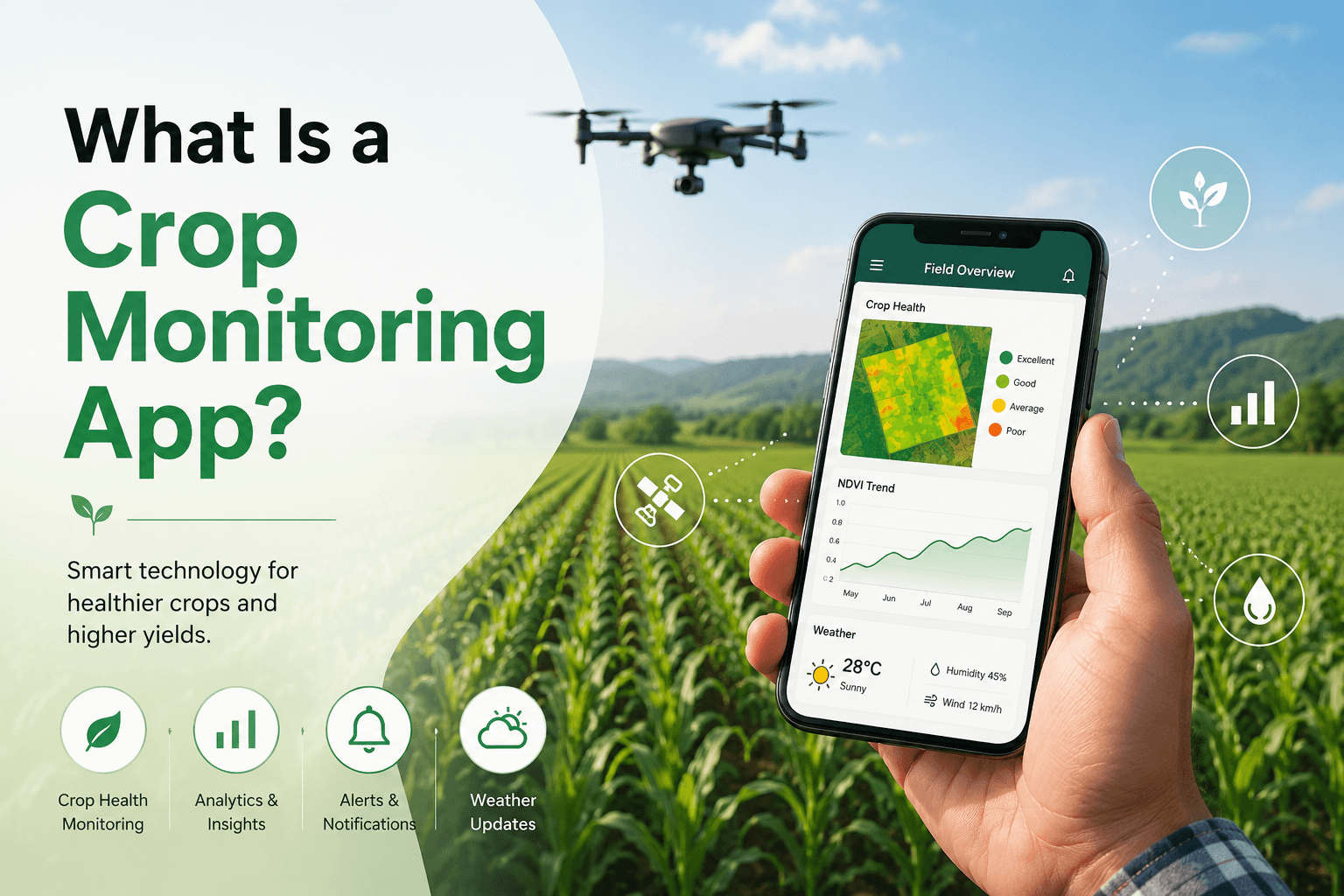
How it works: the app pulls data from multiple sources — satellite imagery (like Sentinel-2 or Landsat), drone-captured aerial photos, ground-based IoT sensors measuring soil moisture and temperature, and third-party weather APIs. It then processes that data using vegetation indices like NDVI (Normalized Difference Vegetation Index) and, increasingly, AI models trained to detect crop stress, disease, or pest pressure before it's visible to a human scouting the field on foot.
Core purpose: turn scattered environmental and biological data into a single, actionable view — so a farm manager can decide where to irrigate, which section needs fertilizer, or where a disease outbreak is starting, without physically walking every acre.
Benefits for farmers and agribusinesses:
Earlier detection of pest and disease pressure
More precise, less wasteful use of water, fertilizer, and pesticide
Better yield forecasting for planning and financial decisions
Reduced labor cost for manual field scouting
Data-backed decision-making instead of guesswork
Why Businesses Are Investing in Crop Monitoring Apps
The push toward digital crop monitoring isn't driven by novelty — it's driven by economics and risk.
Precision agriculture. Instead of treating an entire field uniformly, precision agriculture applies water, fertilizer, and pesticide only where and when it's needed, based on real field data rather than fixed schedules.
Smart farming. Connecting sensors, drones, and software into one system turns farm management from a manual, reactive process into a proactive, data-driven one.
Climate monitoring. With weather volatility increasing, real-time and forecasted climate data embedded directly into farm operations has become essential for planning planting windows and protecting yield.
Yield optimization. Predictive models built on historical and real-time field data help growers estimate — and improve — yield before harvest.
Disease detection. AI-powered image recognition can flag early signs of crop disease from drone or satellite imagery, often before visible symptoms would be spotted by manual scouting.
Sustainability. Precision input application directly reduces water waste, chemical runoff, and the overall environmental footprint of farming operations.
Cost reduction. Less wasted water, fewer unnecessary chemical applications, and reduced labor for manual scouting all show up directly on the bottom line.
Data-driven farming. Perhaps the broadest shift: farm decisions increasingly rely on quantified data rather than experience alone — which matters enormously as farm operations scale beyond what one person can personally observe.
Key Features of Crop Monitoring Apps
Feature | What It Does |
|---|---|
AI Crop Health Detection | Uses image recognition to flag stressed, diseased, or pest-affected crops |
Satellite Monitoring | Pulls multispectral imagery to track field-level vegetation trends over time |
Drone Integration | Ingests high-resolution aerial imagery for granular, field-level analysis |
GPS Tracking | Geo-tags field data, equipment, and scouting reports for precise location context |
GIS Mapping | Visualizes farm data spatially — soil type, elevation, field boundaries |
NDVI Analysis | Calculates vegetation health index from spectral imagery |
Soil Monitoring | Tracks moisture, temperature, pH, and nutrient levels via IoT sensors |
Weather Forecast | Integrates hyperlocal weather data and forecasting for planning decisions |
Irrigation Monitoring | Tracks water usage and automates or recommends irrigation scheduling |
Pest Detection | Flags pest pressure using image recognition and/or environmental modeling |
Fertilizer Recommendation | Suggests fertilizer type and quantity based on soil and crop data |
Disease Prediction | Forecasts disease risk based on environmental conditions and historical patterns |
Yield Forecasting | Predicts expected harvest yield using historical and real-time data |
Push Notifications | Alerts users to urgent field conditions, thresholds, or anomalies |
Farm Analytics Dashboard | Centralizes all farm data into visual, actionable reporting |
Multi-language Support | Serves diverse farming communities and regional workforces |
Offline Mode | Allows data capture in low-connectivity rural field conditions |
Cloud Sync | Synchronizes field data across devices and users once connectivity resumes |
Admin Panel | Manages users, permissions, and farm-level configuration |
Farmer Dashboard | Provides a simplified, action-oriented view for on-the-ground users |
AI Features That Increase App Value
Computer Vision — analyzes drone and satellite images to detect crop stress, disease, and pest damage
Machine Learning — improves prediction accuracy over time as more field data is collected
Predictive Analytics — forecasts yield, disease risk, and optimal harvest timing
Image Recognition — identifies specific pest species or disease types from photos
Chatbots — answer common farmer questions and surface relevant field alerts conversationally
Voice Assistant — enables hands-free field data entry and queries, useful in active field conditions
AI Recommendation Engine — suggests specific actions (irrigation, fertilization, treatment) based on current field data
Smart Alerts — proactively flags anomalies before they become visible problems
Yield Prediction — models expected harvest output using multi-source data
Disease Detection — flags likely disease presence from image and environmental data
Weather Intelligence — combines forecasting with field-specific risk modeling
Top 10 Crop Monitoring App Development Companies (2026)
The companies below range from India- and US-based enterprise software specialists with broad custom development capability, to firms with publicly documented, dedicated agriculture technology practices. Not every company on this list markets itself primarily as an "agritech" specialist — several are general enterprise software developers with the engineering depth to build a crop monitoring platform from the ground up. We've noted this distinction in each profile so you can weigh it against your own priorities.
Top 10 Crop Monitoring App Development Companies (2026)
1. intive
Headquarters: Munich, Germany (with delivery centers across Europe and Latin America)
Founded: 1999
Core Services: Custom software development, mobile app development, cloud engineering, AI/ML, IoT solutions, UX/UI design
Agriculture Expertise: intive develops digital platforms that leverage IoT, AI, and cloud technologies, making it well-suited for precision agriculture, crop monitoring applications, and connected farming ecosystems.
Key Technologies: Flutter, React Native, Kotlin, Swift, Python, AWS, Azure, Google Cloud
Why Choose Them: With more than two decades of experience delivering enterprise software across Europe, intive combines strong product engineering capabilities with modern mobile technologies ideal for agricultural applications.
Pros:
Extensive experience in IoT and cloud-based solutions
Strong UX/UI and mobile engineering expertise
Large European delivery presence
Cons:
Agriculture is one of several industry verticals
Best For: Agritech startups and enterprises seeking scalable crop monitoring applications with IoT integration.
Website: https://www.intive.com
2. Netguru
Headquarters: Poznań, Poland
Founded: 2008
Core Services: Mobile app development, web development, AI solutions, product design, digital consulting
Agriculture Expertise: Netguru develops AI-powered digital products and data-driven applications that can support crop monitoring, farm management, and agricultural analytics platforms.
Key Technologies: React Native, Flutter, Python, Node.js, AWS, Google Cloud
Why Choose Them: Netguru is recognized throughout Europe for building high-quality digital products with an emphasis on user experience and rapid product delivery.
Pros:
Excellent product design capabilities
Strong AI and cloud engineering expertise
Agile development methodology
Cons:
Premium pricing compared to offshore vendors
Best For: European agritech startups and SMEs building innovative crop monitoring platforms.
Website: https://www.netguru.com
3. ELEKS
Headquarters: Tallinn, Estonia (major engineering operations across Europe)
Founded: 1991
Core Services: Software engineering, AI & Data Science, IoT development, cloud services, enterprise consulting
Agriculture Expertise: ELEKS delivers enterprise-grade AI, GIS, and IoT solutions suitable for satellite imagery analysis, crop health monitoring, and precision farming.
Key Technologies: Python, TensorFlow, Azure, AWS, OpenCV, Kubernetes
Why Choose Them: With over 30 years of engineering experience, ELEKS specializes in complex enterprise software and AI-powered analytics.
Pros:
Strong AI and computer vision capabilities
Enterprise-grade software development
Experienced data engineering teams
Cons:
Higher engagement costs for smaller projects
Best For: Large agricultural enterprises requiring advanced analytics and remote sensing platforms.
Website: https://eleks.com
4. Future Processing
Headquarters: Gliwice, Poland
Founded: 2000
Core Services: Custom software development, cloud engineering, AI solutions, data analytics, enterprise applications
Agriculture Expertise: Future Processing develops intelligent software systems capable of supporting precision agriculture, environmental monitoring, and predictive analytics.
Key Technologies: .NET, Java, Python, React, Azure, AWS
Why Choose Them: The company has extensive experience delivering scalable enterprise software with strong quality assurance and long-term technology partnerships.
Pros:
Mature software development processes
Strong cloud engineering expertise
Excellent enterprise support
Cons:
Limited publicly available agriculture-specific projects
Best For: Agribusinesses seeking reliable long-term software development partners.
Website: https://www.future-processing.com
5. 10Clouds
Headquarters: Warsaw, Poland
Founded: 2009
Core Services: Mobile app development, AI software, cloud development, blockchain, product design
Agriculture Expertise: 10Clouds develops AI-enabled mobile applications and cloud platforms suitable for crop health tracking, field monitoring, and farm analytics.
Key Technologies: Flutter, React Native, Python, AWS, Google Cloud
Why Choose Them: The company combines modern product design with emerging technologies to build innovative digital solutions.
Pros:
Strong mobile development capabilities
AI integration expertise
Modern UX/UI design
Cons:
Smaller workforce than larger enterprise vendors
Best For: Startups building next-generation agricultural mobile applications.
Website: https://10clouds.com
6. Software Mind
Headquarters: Kraków, Poland
Founded: 1999
Core Services: Software development, cloud engineering, AI solutions, DevOps, mobile applications
Agriculture Expertise: Software Mind develops cloud-native software platforms that can support IoT-enabled agriculture, sensor networks, and real-time crop monitoring systems.
Key Technologies: Java, Python, React, Kubernetes, AWS, Azure
Why Choose Them: Strong experience in enterprise software modernization and cloud transformation.
Pros:
Large engineering workforce
Strong DevOps expertise
Enterprise-grade delivery
Cons:
Agriculture is not a primary specialization
Best For: Enterprises modernizing agricultural software infrastructure.
Website: https://softwaremind.com
7. Andersen
Headquarters: Warsaw, Poland
Founded: 2007
Core Services: Custom software development, mobile apps, AI/ML, cloud engineering, enterprise software
Agriculture Expertise: Andersen develops custom digital platforms that support IoT, geospatial technologies, and predictive analytics applicable to precision agriculture.
Key Technologies: Flutter, React Native, Java, Python, Azure, AWS
Why Choose Them: The company offers a large pool of experienced software engineers and delivers projects across multiple European markets.
Pros:
Large international development team
Flexible engagement models
Strong mobile engineering expertise
Cons:
Limited agriculture-focused public case studies
Best For: Businesses requiring dedicated development teams for agritech solutions.
Website: https://andersenlab.com
8. Avenga
Headquarters: Cologne, Germany
Founded: 2019 (through the merger of established technology companies)
Core Services: Digital transformation, software engineering, AI, cloud consulting, enterprise applications
Agriculture Expertise: Avenga develops enterprise digital platforms capable of integrating satellite data, IoT devices, and AI-driven crop monitoring systems.
Key Technologies: Azure, AWS, Python, Java, React, Kubernetes
Why Choose Them: Avenga combines enterprise consulting with advanced engineering capabilities across Europe.
Pros:
Strong enterprise consulting
AI and cloud expertise
Global delivery capabilities
Cons:
Higher pricing for enterprise engagements
Best For: Large organizations seeking end-to-end agricultural digital transformation.
Website: https://www.avenga.com
9. Endava
Headquarters: London, United Kingdom
Founded: 2000
Core Services: Digital engineering, cloud services, AI, software development, DevOps
Agriculture Expertise: Endava builds data-intensive digital platforms suitable for crop analytics, environmental monitoring, and precision farming applications.
Key Technologies: Java, Python, AWS, Azure, React, Kubernetes
Why Choose Them: Endava has extensive experience delivering scalable digital transformation projects for enterprise organizations.
Pros:
Strong cloud-native development
Excellent data engineering capabilities
Enterprise delivery expertise
Cons:
Focused primarily on large enterprise clients
Best For: Large agribusinesses requiring scalable, cloud-based crop monitoring platforms.
Website: https://www.endava.com
10. Miquido
Headquarters: Kraków, Poland
Founded: 2011
Core Services: Mobile app development, AI solutions, product design, cloud engineering
Agriculture Expertise: Miquido develops AI-powered mobile applications capable of supporting crop monitoring, predictive analytics, and smart farming solutions.
Key Technologies: Flutter, Kotlin, Swift, Python, TensorFlow, Firebase
Why Choose Them: Miquido has strong expertise in mobile-first development and AI implementation for data-driven applications.
Pros:
Excellent mobile engineering capabilities
Strong AI integration experience
High-quality product design
Cons:
Mid-sized company compared to larger European consultancies
Best For: Agritech startups and businesses developing AI-powered crop monitoring mobile applications.
Website: https://www.miquido.com
Comparison Table
Company | HQ | Founded | Documented Agri Focus | Best For |
|---|---|---|---|---|
Appinventiv | Noida, India | 2014 | Dedicated service page | Startups/SMEs, mobile-first apps |
TatvaSoft | Ahmedabad, India | 2001 | Not documented | Enterprises wanting broad custom dev |
ScienceSoft | McKinney, TX, USA | 1989 | Listed as served sector | Enterprises prioritizing compliance/QA |
Simform | Orlando, FL, USA | 2010 | Not documented | Large-scale cloud/data pipelines |
PixelCrayons | Noida, India | 2004 | Not documented | Budget-conscious startups |
Kellton | Hyderabad, India / Plano, TX | 2009 | Not documented | Public-sector, transparency-focused buyers |
Intellectsoft | Palo Alto, CA, USA | 2007 | Not documented | Security-first enterprise builds |
Chetu | Sunrise, FL, USA | 2000 | Extensive, dedicated AgTech page | Regulatory-heavy, IoT/drone-integrated builds |
Innowise | Warsaw, Poland | 2007 | Dedicated agriculture page | AI-heavy mid-to-large builds |
Intellias | Lviv, Ukraine | 2002 | Dedicated page + documented lab project | GIS/mapping-intensive platforms |
Crop Monitoring App Development Cost
Pricing below reflects typical market ranges for custom crop monitoring app development as of 2026. These are estimates, not fixed quotes — actual pricing depends on your specific feature list, chosen vendor, and region.
Basic App
Estimated Cost: $10,000 – $25,000
Features Included: Farmer dashboard, basic weather integration, manual field data entry, simple reporting, admin panel
Development Time: 2–3 months
Standard App
Estimated Cost: $30,000 – $70,000
Features Included: Satellite/NDVI monitoring, soil sensor integration, irrigation tracking, push notifications, multi-user roles, analytics dashboard
Development Time: 4–6 months
Enterprise AI Platform
Estimated Cost: $80,000 – $250,000+
AI Features: Computer vision-based disease/pest detection, yield prediction models, drone integration, predictive analytics, AI chatbot/assistant, multi-farm/multi-tenant architecture
Development Time: 8–14 months
Regional Cost Variation
Region | Typical Hourly Rate (USD) | Relative Cost Level |
|---|---|---|
India | $15 – $40 | Lowest |
Southeast Asia | $20 – $45 | Low |
Eastern Europe | $30 – $60 | Moderate |
Middle East | $35 – $70 | Moderate–High |
UK | $60 – $110 | High |
Australia | $65 – $120 | High |
USA | $80 – $150+ | Highest |
Why pricing differs by region: the gap comes down to cost of living, local salary benchmarks for software engineers, currency exchange dynamics, and market demand. A US or Australian-based team isn't necessarily higher quality than an Indian or Eastern European one — it typically reflects local operating costs. Many agribusinesses successfully use a hybrid model: local project leadership paired with an offshore engineering team, capturing both cost efficiency and close stakeholder communication.
Cost Breakdown by Development Component
Component | Estimated Cost (USD) | % of Total Budget (typical) |
|---|---|---|
Research & Discovery | $2,000 – $6,000 | 5–8% |
UI/UX Design | $4,000 – $12,000 | 10–15% |
Frontend (Mobile) Development | $10,000 – $30,000 | 20–25% |
Backend Development | $15,000 – $40,000 | 25–30% |
AI/ML Development | $10,000 – $50,000+ | Varies by AI feature depth |
IoT Integration | $5,000 – $20,000 | 8–12% |
GIS Integration | $5,000 – $15,000 | 8–10% |
API Development | $4,000 – $12,000 | 6–10% |
Testing & QA | $5,000 – $15,000 | 10–12% |
Deployment | $2,000 – $6,000 | 3–5% |
Cloud Hosting (annual) | $3,000 – $20,000+ | Ongoing |
Security Implementation | $3,000 – $10,000 | 5–8% |
DevOps Setup | $3,000 – $10,000 | 5–8% |
Post-Launch Maintenance (annual) | 15–20% of dev cost | Ongoing |
Factors Affecting Development Cost
Feature count and complexity — each additional module (drone integration, AI disease detection, multi-farm management) adds engineering time
AI integration depth — a simple rules-based alert system costs far less than a trained computer vision model for disease detection
Drone connectivity — integrating live drone feeds and flight-path automation adds meaningful backend complexity
IoT device integration — connecting to soil sensors, weather stations, and other hardware requires device-specific protocol handling
Satellite API costs — providers like Sentinel Hub or Google Earth Engine may involve usage-based licensing fees layered on top of development cost
Third-party API integrations — weather services, payment gateways, or ERP systems each add integration and testing time
Cloud infrastructure choices — architecture decisions affect both development cost and ongoing operational expense
Number of platforms — building for iOS, Android, and web simultaneously costs more than a single-platform MVP
Scalability requirements — a platform built to serve thousands of farms from day one requires more architectural planning than a single-farm tool
Compliance requirements — data protection and, in some markets, agricultural data-sharing regulations add engineering and legal review time
Ongoing maintenance needs — apps with frequent AI model retraining or evolving sensor integrations cost more to maintain long-term
Recommended Technology Stack
Layer | Common Technologies |
|---|---|
Frontend (Mobile) | Flutter, React Native |
Backend | Node.js, Python, Java |
Database | PostgreSQL, MongoDB |
Cloud | AWS, Microsoft Azure, Google Cloud |
AI/ML | TensorFlow, PyTorch, OpenCV |
Maps | Google Maps, Mapbox |
Satellite Data | Sentinel Hub, Google Earth Engine |
IoT Connectivity | MQTT, LoRaWAN |
This stack reflects what's currently standard across the industry rather than a single "correct" combination — the right choice depends on your team's existing infrastructure and your specific data source requirements.
Development Timeline
Phase | Estimated Duration |
|---|---|
Discovery & Requirements | 1–3 weeks |
UI/UX Design | 2–4 weeks |
MVP Development | 6–10 weeks |
Backend Development | 8–16 weeks |
AI Integration | 4–10 weeks |
Testing & QA | 3–6 weeks |
Deployment | 1–2 weeks |
Post-Launch Maintenance | Ongoing |
A Basic-tier app can realistically launch in 2–3 months; a full Enterprise AI platform typically takes 8–14 months from discovery to production launch.
Benefits of Crop Monitoring Apps
Better crop yields through earlier problem detection and more precise interventions
Lower farming costs via reduced waste of water, fertilizer, and pesticide
Water conservation through data-driven, targeted irrigation
Improved pest management with earlier detection and more targeted treatment
Faster decision-making with real-time field data instead of periodic manual inspection
Higher profitability from the combined effect of yield improvement and cost reduction
More sustainable farming through reduced chemical runoff and resource waste
Reduced labor requirements for manual field scouting
Challenges
Data quality — sensor calibration issues or inconsistent data collection can undermine model accuracy
Connectivity — many farming regions have limited or unreliable internet access, making offline-first design essential
High implementation cost — enterprise-grade platforms with AI and IoT integration represent a meaningful upfront investment
User adoption — older or less tech-familiar farming staff may need structured onboarding and training
Security — farm operational and financial data requires proper protection, particularly as platforms scale
AI model training — building accurate disease/pest detection models requires substantial labeled training data specific to relevant crop types and regions
Hardware integration — connecting diverse IoT sensors and drone systems from different manufacturers can introduce compatibility challenges
Future Trends (2026–2035)
Autonomous farming — self-operating equipment coordinated through the same platforms that monitor crop health
AI agents — systems capable of independently executing multi-step farm management tasks, not just flagging issues
Agricultural robotics — increasing integration between monitoring software and robotic field equipment
Satellite AI — more sophisticated on-orbit and near-real-time satellite analysis capability
Digital twins — virtual field models used to simulate outcomes before making real-world changes
Hyperlocal weather intelligence — increasingly granular, field-specific forecasting rather than regional averages
Carbon farming — software supporting carbon credit tracking and verification tied to sustainable farming practices
Blockchain — traceability applications for supply chain transparency from field to consumer
Edge AI — processing AI models directly on field hardware to reduce dependency on constant connectivity
Predictive agriculture — moving from reactive alerts to proactive, forecasted recommendations across the full growing season
How to Choose the Right Development Company
✅ Ask for documented agriculture or agritech project experience — not just a general portfolio
✅ Verify AI/ML expertise with specific examples of computer vision or predictive modeling work
✅ Request client references, ideally from agriculture or adjacent IoT-heavy industries
✅ Confirm pricing transparency — ask for an itemized quote, not a single lump sum
✅ Review their approach to data security, especially for farm operational and financial data
✅ Evaluate communication practices and time zone overlap before committing
✅ Confirm post-launch support and maintenance terms in writing
✅ Assess their experience with the specific technologies your project needs — satellite APIs, IoT protocols, drone integration
✅ Ask directly how they'd approach scalability if your farm network grows significantly
✅ Request a fixed-scope quote for an MVP phase before committing to a larger, open-ended engagement
Crop Monitoring App Development Cost-Saving Tips
Start with a clearly scoped MVP rather than building every feature at once
Prioritize the two or three features that solve your biggest operational pain point first
Use existing satellite data APIs (Sentinel Hub, Google Earth Engine) instead of building custom satellite processing
Choose cloud infrastructure over on-premise hosting unless there's a specific reason not to
Reserve custom AI model training for the features where accuracy genuinely matters most
Standardize on common IoT communication protocols (MQTT, LoRaWAN) to simplify sensor integration
Avoid excessive platform customization for low-impact features
Build a detailed requirements document before requesting quotes to avoid costly scope changes mid-project
Consider a hybrid team model — local oversight paired with offshore engineering
Negotiate a fixed-scope MVP contract, then shift to time-and-materials for iterative feature additions
Frequently Asked Questions
1. How much does crop monitoring app development cost?
Costs typically range from $10,000 for a basic app to $250,000+ for a full enterprise AI-powered platform, depending on features, AI depth, and development region.
2. Which company is best for agricultural app development?
It depends on your priorities. Companies like Chetu, Innowise, and Intellias have the most publicly documented, agriculture-specific technical experience, while firms like ScienceSoft, Intellectsoft, and Simform bring broader enterprise engineering depth that can be applied to agriculture projects.
3. How long does it take to build a crop monitoring app?
A basic app can launch in 2–3 months; a full enterprise AI platform typically takes 8–14 months.
4. Can AI detect crop diseases?
Yes. Computer vision models trained on labeled crop imagery can identify visual symptoms of many diseases, often before they'd be noticeable to the human eye during routine field scouting.
5. What APIs are used in agriculture apps?
Common integrations include satellite data providers (Sentinel Hub, Google Earth Engine), weather APIs, mapping services (Google Maps, Mapbox), and IoT sensor platforms.
6. Is drone integration expensive?
Drone software integration typically adds $5,000–$20,000+ to development cost, depending on the complexity of flight automation and image processing required.
7. Can small farms use crop monitoring apps?
Yes — many companies now build lightweight, lower-cost apps specifically for smaller operations, though the ROI calculation matters more at smaller scale than for large agribusinesses.
8. Which technology stack is best?
There's no single "best" stack — React Native or Flutter for mobile, Node.js or Python for backend, and PostgreSQL or MongoDB for databases are all common, proven choices depending on team expertise and project needs.
9. How much does maintenance cost?
Budget roughly 15–20% of your original development cost annually for ongoing maintenance, updates, and hosting.
10. What is the ROI of crop monitoring apps?
ROI varies significantly by farm size and prior inefficiency levels, but the primary drivers are reduced input waste (water, fertilizer, pesticide), earlier disease/pest intervention, and improved yield forecasting accuracy for financial planning.
11. Do I need satellite imagery, drone imagery, or both?
Satellite imagery is cost-effective for broad, periodic monitoring across large areas; drones provide higher-resolution, more frequent imagery for smaller or high-value fields. Many enterprise platforms use both, applying each where it's most cost-effective.
12. Can a crop monitoring app work without internet access in the field?
Yes, if designed with offline-first architecture — data is captured locally and synced once connectivity is available, which is essential for many rural farming regions.
13. Do these apps require IoT hardware, or can they work with software alone?
Both models exist. Satellite- and weather-data-only apps require no hardware investment, while apps incorporating soil sensors or automated irrigation require IoT device deployment in the field.
14. How accurate are AI yield predictions?
Accuracy improves significantly with more historical field-specific data; a model trained on a single season's data will be far less reliable than one refined across multiple growing seasons and crop varieties.
15. Should I build for a single farm or a multi-tenant platform serving many farms?
This is one of the biggest cost and architecture decisions in scoping the project — multi-tenant platforms require more upfront architectural planning but scale far more efficiently if you intend to serve multiple customers or a distributed farm network.
16. What's the difference between a farm management app and a crop monitoring app?
Crop monitoring focuses specifically on field-level plant health and environmental tracking; farm management is broader, often including equipment, labor, financials, and supply chain in addition to crop monitoring.
17. Can crop monitoring apps integrate with existing ERP or accounting systems?
Yes, most enterprise-tier builds include API integrations with existing farm management, ERP, or accounting systems to avoid duplicate data entry.
18. What regulatory considerations apply to agriculture software in the US?
Depending on the platform's scope, compliance may touch on USDA, FDA, FSIS, or EPA reporting requirements — particularly for supply chain, food safety, or environmental discharge-related features.
19. How is pricing typically structured with development agencies?
Most agencies quote a fixed price for a clearly scoped MVP, then move to time-and-materials billing for ongoing feature development and iteration.
20. What's the first step in starting a crop monitoring app project?
A structured discovery phase — mapping your specific crops, farm scale, data sources, and priority use cases into a documented technical scope before requesting development quotes.
Conclusion
Crop monitoring apps have moved from a competitive edge to something close to standard infrastructure for serious agricultural operations. The technology — satellite imagery, IoT sensors, computer vision, predictive analytics — has matured enough that the real differentiator today isn't whether the capability exists, but how well it's tailored to your specific crops, region, and operational scale.
Development cost varies widely, from roughly $10,000 for a lean MVP to well over $200,000 for a full AI-powered enterprise platform — and the right number depends entirely on how much of that feature list you actually need at launch versus what can be phased in later. The companies profiled here span a genuine range: some bring deep, documented agriculture-specific experience, while others bring broader enterprise engineering strength that translates well to agricultural use cases. Neither approach is automatically better — it depends on how specialized your requirements are and how much you value seeing prior agtech work firsthand.
Whichever path you take, the fundamentals hold: scope a clear MVP, prioritize the features that solve your biggest operational problem first, and choose a partner whose past work — agriculture-specific or not — genuinely demonstrates the technical depth your project needs.
Ready to move forward? Reach out to a development partner for a detailed, itemized quote based on your specific crop types, farm scale, and feature priorities — the estimates in this guide are a starting point for that conversation, not a substitute for it.
[ Blog ]


